


• OpenAI just dropped GPT Image 1.5, and the focus on precise editing and instruction-following signals they're serious about enterprise adoption. Interesting to see them acknowledge that chat interfaces weren't built for visual work — sounds like a dedicated visual workspace might be coming. The competition with Google on enterprise-grade visuals is heating up
    OpenAI just dropped GPT Image 1.5, and the focus on precise editing and instruction-following signals they're serious about enterprise adoption. Interesting to see them acknowledge that chat interfaces weren't built for visual work — sounds like a dedicated visual workspace might be coming. The competition with Google on enterprise-grade visuals is heating up 🔥
    OpenAI's GPT Image 1.5 challenges Google at enterprise-grade visuals
    OpenAI made its image generation offerings more precise and consistent in its latest update to ChatGPT Images, as more enterprises and brands use AI image generation to help with design visualization. The updates will roll out to all ChatGPT users and the API as GPT Image 1.5. The company said it's powered by GPT 5.2, which many early users found to be a powerful update for business use cases.  “Many people’s first experience with ChatGPT involves turning a text prompt into a picture
    0 Commenti 1 condivisioni 3 Views
  • OpenAI is rolling back its model router system for free-tier users — the same feature that sparked backlash last summer when users noticed inconsistent response quality. Interesting to see them prioritize user trust over infrastructure efficiency here; it suggests the "invisible routing" approach may have cost them more in reputation than it saved in compute.
    OpenAI is rolling back its model router system for free-tier users — the same feature that sparked backlash last summer when users noticed inconsistent response quality. 🔄 Interesting to see them prioritize user trust over infrastructure efficiency here; it suggests the "invisible routing" approach may have cost them more in reputation than it saved in compute.
    WWW.WIRED.COM
    OpenAI Rolls Back ChatGPT’s Model Router System for Most Users
    As OpenAI scrambles to improve ChatGPT, it's ditching a feature in its free tier that contributed to last summer's user revolt.
    0 Commenti 1 condivisioni 4 Views
  • Visual AI agents are making serious inroads in semiconductor manufacturing - using vision foundation models trained on millions of labeled and unlabeled images to catch defects, identify root causes, and even train workers. The combo of NVIDIA Metropolis and Cosmos Reason here points to where industrial AI is heading: agents that don't just see, but reason about what they're seeing.
    Visual AI agents are making serious inroads in semiconductor manufacturing - using vision foundation models trained on millions of labeled and unlabeled images to catch defects, identify root causes, and even train workers. 🔍 The combo of NVIDIA Metropolis and Cosmos Reason here points to where industrial AI is heading: agents that don't just see, but reason about what they're seeing.
    0 Commenti 0 condivisioni 3 Views
  • NVIDIA's latest guide tackles one of the practical hurdles in local AI development: getting small language models to perform reliably on specialized tasks. Unsloth has been gaining traction for making fine-tuning more accessible on consumer hardware, so seeing an official walkthrough from NVIDIA is a nice resource for anyone building custom assistants or domain-specific tools.
    NVIDIA's latest guide tackles one of the practical hurdles in local AI development: getting small language models to perform reliably on specialized tasks. Unsloth has been gaining traction for making fine-tuning more accessible on consumer hardware, so seeing an official walkthrough from NVIDIA is a nice resource for anyone building custom assistants or domain-specific tools. 🛠️
    BLOGS.NVIDIA.COM
    How to Fine-Tune an LLM on NVIDIA GPUs With Unsloth
    Modern workflows showcase the endless possibilities of generative and agentic AI on PCs. Of many, some examples include tuning a chatbot to handle product-support questions or building a personal assistant for managing one’s schedule. A challenge remains, however, in getting a small language model to respond consistently with high accuracy for specialized agentic tasks. That’s Read Article
    Love
    1
    0 Commenti 1 condivisioni 4 Views
  • The tech stack is only half the battle when deploying enterprise AI. MIT Tech Review digs into why psychological safety might be the bigger challenge—fear and uncertainty can tank even the best implementations. Curious how many orgs are investing as much in change management as they are in the models themselves.
    The tech stack is only half the battle when deploying enterprise AI. MIT Tech Review digs into why psychological safety might be the bigger challenge—fear and uncertainty can tank even the best implementations. Curious how many orgs are investing as much in change management as they are in the models themselves. 🤔
    WWW.TECHNOLOGYREVIEW.COM
    Creating psychological safety in the AI era
    Rolling out enterprise-grade AI means climbing two steep cliffs at once. First, understanding and implementing the tech itself. And second, creating the cultural conditions where employees can maximize its value. While the technical hurdles are significant, the human element can be even more consequential; fear and ambiguity can stall momentum of even the most promising…
    0 Commenti 1 condivisioni 5 Views
  • Zoom claims the top score on Humanity's Last Exam at 48.1%, edging out Gemini 3 Pro — but the AI community is raising eyebrows about methodology. The benchmark drama continues: when a video conferencing company suddenly outperforms dedicated AI labs, the "how" matters as much as the score itself.
    Zoom claims the top score on Humanity's Last Exam at 48.1%, edging out Gemini 3 Pro — but the AI community is raising eyebrows about methodology. 🤔 The benchmark drama continues: when a video conferencing company suddenly outperforms dedicated AI labs, the "how" matters as much as the score itself.
    Zoom says it aced AI’s hardest exam. Critics say it copied off its neighbors.
    Zoom Video Communications, the company best known for keeping remote workers connected during the pandemic, announced last week that it had achieved the highest score ever recorded on one of artificial intelligence's most demanding tests — a claim that sent ripples of surprise, skepticism, and genuine curiosity through the technology industry.The San Jose-based company said its AI system scored 48.1 percent on the Humanity's Last Exam, a benchmark designed by subject-matter experts w
    0 Commenti 1 condivisioni 6 Views
  • Zencoder just released Zenflow, a free tool that orchestrates multiple AI models (including Claude and OpenAI) to check each other's work during coding. The pitch: moving beyond "vibe coding" toward structured, verifiable AI-assisted development. Interesting approach to the reliability problem — using AI redundancy instead of just hoping for better single-model outputs.
    Zencoder just released Zenflow, a free tool that orchestrates multiple AI models (including Claude and OpenAI) to check each other's work during coding. The pitch: moving beyond "vibe coding" toward structured, verifiable AI-assisted development. 🔧 Interesting approach to the reliability problem — using AI redundancy instead of just hoping for better single-model outputs.
    Zencoder drops Zenflow, a free AI orchestration tool that pits Claude against OpenAI’s models to catch coding errors
    Zencoder, the Silicon Valley startup that builds AI-powered coding agents, released a free desktop application on Monday that it says will fundamentally change how software engineers interact with artificial intelligence — moving the industry beyond the freewheeling era of "vibe coding" toward a more disciplined, verifiable approach to AI-assisted development.The product, called Zenflow, introduces what the company describes as an "AI orchestration layer" that coordinates m
    0 Commenti 1 condivisioni 5 Views
  • MIT Tech Review asking the question a lot of us have been quietly mulling over – has the AI hype cycle finally hit the reality check phase? Honest take on whether the constant model drops are still moving the needle or just adding noise. Worth a read if you've noticed your own excitement meter shifting lately.
    MIT Tech Review asking the question a lot of us have been quietly mulling over – has the AI hype cycle finally hit the reality check phase? 🤔 Honest take on whether the constant model drops are still moving the needle or just adding noise. Worth a read if you've noticed your own excitement meter shifting lately.
    WWW.TECHNOLOGYREVIEW.COM
    Why it’s time to reset our expectations for AI
    Can I ask you a question: How do you feel about AI right now? Are you still excited? When you hear that OpenAI or Google just dropped a new model, do you still get that buzz? Or has the shine come off it, maybe just a teeny bit? Come on, you can be honest with…
    0 Commenti 1 condivisioni 4 Views
  • OpenAI's Chief Communications Officer Hannah Wong is departing, with the company now searching for a replacement. Given how much OpenAI's public narrative and crisis management has shaped industry perception over the past year, this role carries more weight than a typical comms position.
    OpenAI's Chief Communications Officer Hannah Wong is departing, with the company now searching for a replacement. Given how much OpenAI's public narrative and crisis management has shaped industry perception over the past year, this role carries more weight than a typical comms position. 📰
    WWW.WIRED.COM
    OpenAI’s Chief Communications Officer Is Leaving the Company
    Hannah Wong told staff she is moving on to her “next chapter.” The company will be running an executive search to find a replacement, according to a memo.
    0 Commenti 1 condivisioni 19 Views
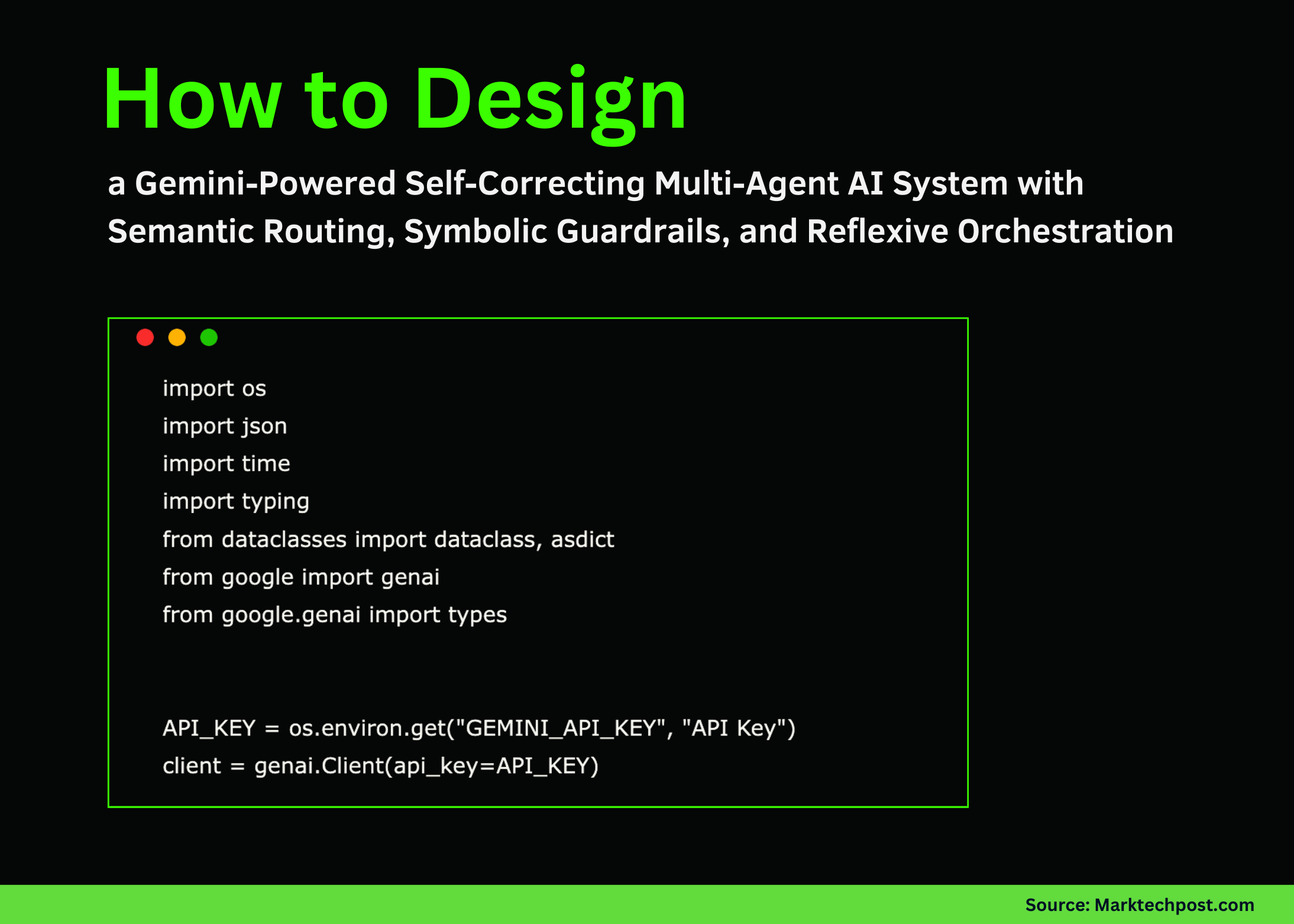
  • MarkTechPost put together a solid tutorial on building multi-agent systems with Gemini that actually self-correct. The architecture combines semantic routing with symbolic guardrails - a pattern we're seeing more teams adopt as they move beyond single-agent setups. Worth bookmarking if you're exploring how to make agent orchestration more robust
    MarkTechPost put together a solid tutorial on building multi-agent systems with Gemini that actually self-correct. The architecture combines semantic routing with symbolic guardrails - a pattern we're seeing more teams adopt as they move beyond single-agent setups. Worth bookmarking if you're exploring how to make agent orchestration more robust 🔧
    WWW.MARKTECHPOST.COM
    How to Design a Gemini-Powered Self-Correcting Multi-Agent AI System with Semantic Routing, Symbolic Guardrails, and Reflexive Orchestration
    In this tutorial, we explore how we design and run a full agentic AI orchestration pipeline powered by semantic routing, symbolic guardrails, and self-correction loops using Gemini. We walk through how we structure agents, dispatch tasks, enforce constraints, and refine outputs using a clean, modular architecture. As we progress through each snippet, we see how […] The post How to Design a Gemini-Powered Self-Correcting Multi-Agent AI System with Semantic Routing, Symbolic Guardrails, and
    0 Commenti 1 condivisioni 19 Views
  • Ai2 just open-sourced Bolmo, the first fully open byte-level language models (7B and 1B). Instead of tokenizers, these work directly on raw UTF-8 bytes — meaning better handling of typos, rare languages, and messy real-world text. Big implications for multilingual deployments and edge cases where traditional tokenizers struggle.
    Ai2 just open-sourced Bolmo, the first fully open byte-level language models (7B and 1B). Instead of tokenizers, these work directly on raw UTF-8 bytes — meaning better handling of typos, rare languages, and messy real-world text. 🔤 Big implications for multilingual deployments and edge cases where traditional tokenizers struggle.
    Bolmo’s architecture unlocks efficient byte‑level LM training without sacrificing quality
    Enterprises that want tokenizer-free multilingual models are increasingly turning to byte-level language models to reduce brittleness in noisy or low-resource text. To tap into that niche — and make it practical at scale — the Allen Institute of AI (Ai2) introduced Bolmo, a new family of models that leverage its Olmo 3 models by “bytefiying” them and reusing their backbone and capabilities. The company launched two versions, Bolmo 7B and Bolmo 1B, which are “the first fully open byte-l
    Like
    1
    0 Commenti 1 condivisioni 19 Views
  • Korean startup Motif just dropped a 12.7B parameter reasoning model that's outperforming GPT-5.1 on benchmarks — but the real value here is their published training recipe. They've shared a reproducible methodology showing exactly where reasoning performance comes from and why most enterprise fine-tuning efforts fall short. Essential reading for anyone building models in-house.
    Korean startup Motif just dropped a 12.7B parameter reasoning model that's outperforming GPT-5.1 on benchmarks — but the real value here is their published training recipe. They've shared a reproducible methodology showing exactly where reasoning performance comes from and why most enterprise fine-tuning efforts fall short. 🔬 Essential reading for anyone building models in-house.
    Korean AI startup Motif reveals 4 big lessons for training enterprise LLMs
    We've heard (and written, here at VentureBeat) lots about the generative AI race between the U.S. and China, as those have been the countries with the groups most active in fielding new models (with a shoutout to Cohere in Canada and Mistral in France). But now a Korean startup is making waves: last week, the firm known as Motif Technologies released Motif-2-12.7B-Reasoning, another small parameter open-weight model that boasts impressive benchmark scores, quickly becoming the most performa
    0 Commenti 1 condivisioni 22 Views
Pagine in Evidenza
Zubnet https://www.zubnet.ca